Ashwagandha has gone from a traditional Ayurvedic herb to one of the most recognizable supplements for stress. You'll now find it in capsules, gummies, powders, teas, and wellness drinks, often with promises around cortisol, sleep, anxiety, and "hormone balance."
So what does ashwagandha actually do?
The strongest human research points to stress support, with additional evidence for cortisol and sleep. Some studies also suggest benefits for anxiety, although results are less consistent. Just as important, not every ashwagandha product is the same. Root powder, standardized extracts such as KSM-66, and root-and-leaf formulas can differ considerably.
What is ashwagandha?
Ashwagandha is the common name for Withania somnifera, an evergreen shrub that has been used for centuries in Ayurvedic medicine.
Modern supplements typically use the root, the leaf, or extracts made from one or both parts of the plant.
Ashwagandha is often called an adaptogen, a term commonly used for substances studied for their potential to help the body respond to physical and psychological stress.
It also contains naturally occurring compounds called withanolides. Supplement manufacturers can standardize extracts to contain a defined amount of these compounds, which helps make one batch more consistent with the next.
That matters because a concentrated extract and plain ashwagandha root powder are not interchangeable milligram for milligram.
What are the main benefits of ashwagandha?
Ashwagandha has been studied for many different purposes, but the evidence is stronger for some claims than others.
The broader research on ashwagandha's main benefits looks at these outcomes in more detail.
Stress and cortisol
Stress is where ashwagandha has built much of its reputation.
A 2024 meta-analysis of nine randomized trials involving 558 participants found improvements in perceived stress and anxiety measures, along with lower cortisol.
Research has continued to grow. By 2026, a systematic review and meta-analysis was able to evaluate 23 randomized trials looking at hormonal outcomes associated with ashwagandha.
That larger body of research makes stress and cortisol some of the more evidence-backed reasons people consider the herb.
Sleep
Ashwagandha may also support sleep, particularly in people already experiencing sleep problems.
A 2021 systematic review and meta-analysis of five randomized trials found a modest overall improvement in sleep, with a stronger effect in people with insomnia.
That does not necessarily mean ashwagandha works like a sleeping pill. Most studies look at regular use over several weeks rather than a single dose taken before bed.
Anxiety
Some studies also report improvements in anxiety symptoms.
The evidence overlaps heavily with stress research because many trials recruit people experiencing elevated stress rather than people with a diagnosed anxiety disorder.
For that reason, ashwagandha is better understood as a stress-support supplement with some promising anxiety findings rather than a treatment for anxiety disorders.
Why has ashwagandha become so popular?
Part of the answer is simple: stress and poor sleep are common problems, and ashwagandha is marketed directly around both.
But its popularity is not entirely driven by social media.
Human research has expanded significantly over the past decade. Rather than relying on one or two small studies, researchers can now compare findings across multiple randomized trials and meta-analyses.
That does not mean every claim made about ashwagandha is supported.
The more repeatable benefits tend to cluster around:
- stress
- cortisol
- sleep
- some anxiety-related outcomes
Claims that it dramatically boosts metabolism, balances every hormone, melts body fat, or fixes adrenal problems go much further than current research supports.
Ashwagandha is also now widely used. A 2024 study in JAMA Network Open estimated that millions of US adults were using botanical supplements including ashwagandha. Widespread use makes understanding both the benefits and safety considerations increasingly important.
Does ashwagandha balance hormones?
"Hormone balance" is one of the broadest claims attached to ashwagandha, but the research is more specific.
Its clearest hormone-related evidence involves cortisol, one of the hormones involved in the body's stress response.
Direct effects on estrogen or testosterone in women have not been demonstrated consistently enough to say that ashwagandha broadly "balances hormones."
Stress support can still be relevant to hormonal health. Poor sleep, persistent stress, and reduced resilience can become particularly noticeable during perimenopause and menopause.
The research on ashwagandha's benefits for women looks more closely at where the evidence overlaps with common concerns across different stages of women's health.
Ashwagandha root powder vs extract: what's the difference?
The form of ashwagandha matters more than many supplement labels make obvious.
The NIH Office of Dietary Supplements notes that clinical studies use different plant parts, extracts, levels of standardization, and doses.
That means comparing products only by the milligram number on the front of the package can be misleading.
Ashwagandha root powder
Root powder is simply dried and ground ashwagandha root.
Because it is less concentrated, products often use larger amounts of root powder than they would of a standardized extract.
Standardized ashwagandha extract
An extract concentrates components of the plant.
A standardized extract is produced so selected compounds remain within a defined range from batch to batch. This gives the ingredient a more consistent identity and makes it easier to compare with the preparation used in clinical research.
What is KSM-66 ashwagandha?
KSM-66 is one specific standardized ashwagandha root extract used in human studies.
KSM-66 is not another herb or a different species of ashwagandha. It is a particular preparation of Withania somnifera.
This distinction matters.
Two products may both say they contain "300 mg ashwagandha," while actually providing very different preparations. The plant part, extraction method, concentration, and standardization can all change what that 300 mg represents.
Capsules, gummies, powders or tea: does the form matter?
Capsules and gummies mainly describe how you take the ingredient. They do not tell you which type of ashwagandha is inside.
A capsule might contain:
- plain root powder
- a standardized root extract
- a root-and-leaf extract
- ashwagandha combined with other ingredients
The same is true for gummies and drink powders.
Ashwagandha tea is somewhat different. It typically uses root material steeped or simmered in water.
Most modern randomized studies on stress and sleep use defined extracts, which makes a cup of tea difficult to compare directly with the doses used in research.

How to choose an ashwagandha supplement
A useful supplement label should make it easy to tell exactly what form of ashwagandha you're getting.
Look for:
The biggest milligram number is not automatically the best choice.
A clearly identified extract that can be matched to human research is generally more informative than a large number attached to an unspecified ashwagandha powder.
Is ashwagandha safe?
Ashwagandha is generally well tolerated by many adults in short-term clinical studies.
Most research has followed people for several weeks to a few months, so there is less information about continuous long-term use.
Common ashwagandha side effects
When side effects occur, they are usually mild.
Commonly reported effects include:
- stomach upset
- nausea
- diarrhea
- drowsiness
If ashwagandha makes you unusually sleepy or causes persistent digestive symptoms, stop taking it and review the product with a clinician or pharmacist.
Who should avoid or be careful with ashwagandha?
Some people should be more cautious.
The National Center for Complementary and Integrative Health provides current federal safety guidance.
Liver and thyroid considerations
Rare liver-related reactions have been reported with ashwagandha.
A 2026 scoping review identified 25 patients across 13 published reports. Most recovered after stopping the supplement and receiving supportive care.
Those cases do not tell us how commonly liver injury occurs among everyone taking ashwagandha, but they are still an important safety consideration.
Ashwagandha may also influence thyroid function.
A small randomized trial found that 8 weeks of ashwagandha root extract changed several thyroid hormone measurements in adults with mild thyroid underactivity.
If you have a thyroid condition, significant liver disease, or take thyroid medication, discuss ashwagandha with your clinician before using it regularly.
Where ashwagandha fits in Harmonia
%20(1).jpeg)
Ashwagandha has a clear role in Harmonia: supporting the body's response to ongoing stress.
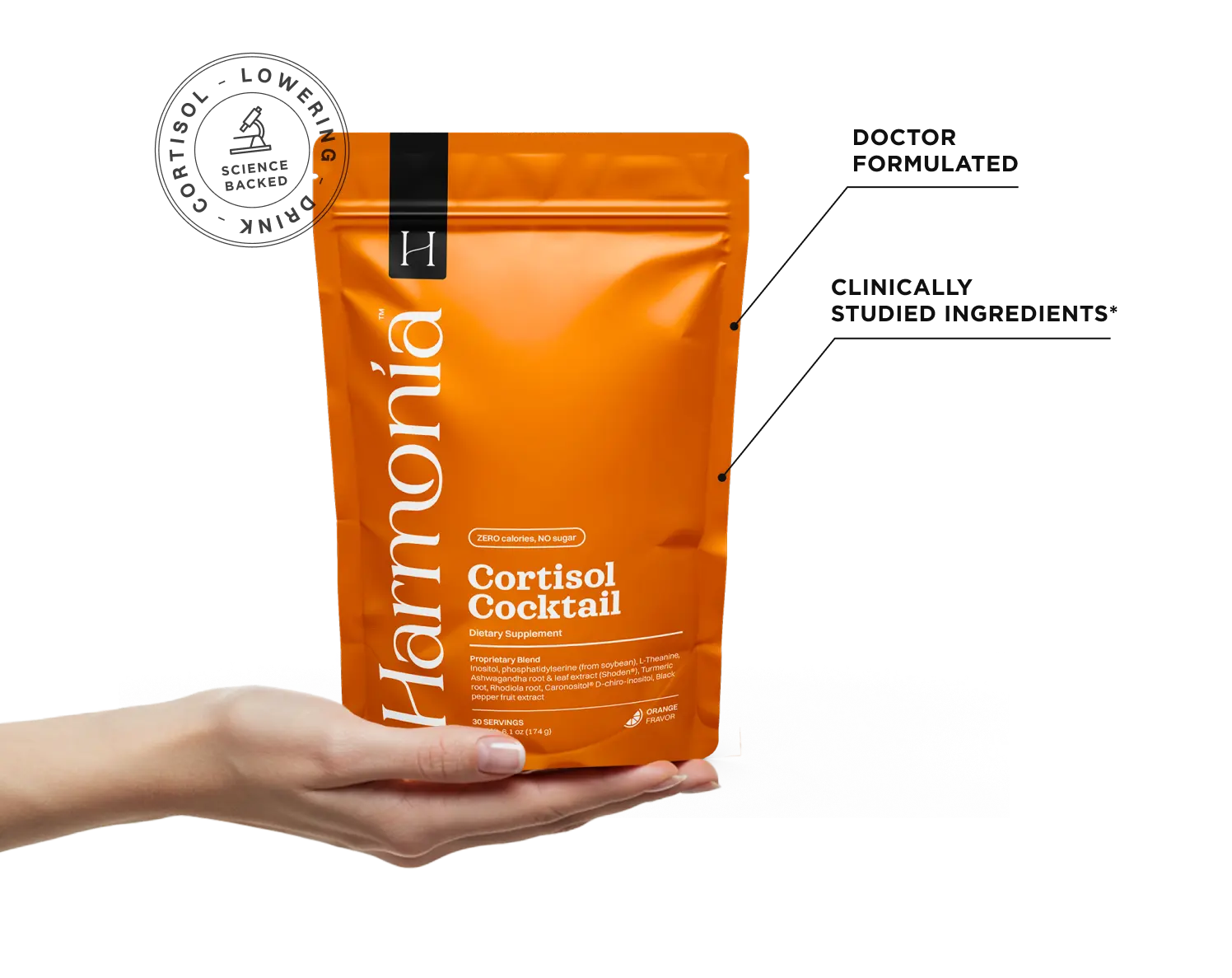
The Harmonia Cortisol Cocktail uses KSM-66, a standardized ashwagandha root extract with human research behind stress and cortisol outcomes.
But ashwagandha is only one part of the formula.
The Harmonia Cortisol Cocktail ingredient list pairs KSM-66 with ingredients that support other ways ongoing stress can show up. L-theanine supports calm focus, Rhodiola rosea is studied for stress-related fatigue, magnesium supports normal nervous-system function, and inositols are involved in insulin and hormone signaling.
That gives KSM-66 a defined place in the formula: the ashwagandha-based stress and cortisol component, while the surrounding ingredients address other parts of the broader stress picture.
The bottom line
Ashwagandha is one of the better-studied herbal supplements for stress support.
Its strongest human evidence centers on perceived stress and cortisol, with additional research suggesting modest sleep benefits and possible improvements in anxiety symptoms.
The type of ashwagandha matters. A named standardized extract such as KSM-66 is easier to connect with clinical research than a generic milligram amount on a supplement label.
Ashwagandha is also not right for everyone. Pregnancy, breastfeeding, thyroid conditions, autoimmune conditions, liver concerns, surgery, and certain medications all deserve extra caution.
For women who want KSM-66 as part of a broader caffeine-free approach to everyday stress, the Harmonia Cortisol Cocktail combines it with ingredients selected for calm focus, stress-related fatigue, nervous-system support, and hormone-related signaling.
If stress keeps affecting your sleep, focus, energy, or daily routine, you can take the Harmonia quiz to see whether the Cortisol Cocktail fits what you're experiencing.
Frequently asked questions
What is ashwagandha used for?
Ashwagandha is best known for stress support. Human studies also suggest benefits for cortisol and sleep, with some evidence for anxiety-related symptoms.
What does ashwagandha do to your body?
Ashwagandha appears to influence parts of the body's stress response. Human studies have reported changes in perceived stress and cortisol, while other research has looked at sleep and anxiety outcomes.
Why is ashwagandha so popular?
Its rise reflects both wellness trends and a growing body of human research. Stress and sleep are common reasons people take it, and the number of randomized trials studying ashwagandha has increased significantly.
Is ashwagandha the same as KSM-66?
No. Ashwagandha is the plant, while KSM-66 is a specific standardized extract made from ashwagandha root.
Is ashwagandha good for stress?
Stress is one of the strongest areas of human research for ashwagandha. Multiple randomized trials and meta-analyses have reported improvements in perceived stress, with several also finding lower cortisol.
Does ashwagandha help with sleep?
It may. A systematic review found modest improvements in sleep overall, with a stronger effect in people experiencing insomnia. Most research looks at regular use rather than a one-time bedtime dose.
Does ashwagandha balance hormones?
Its clearest hormone-related evidence involves cortisol. Current research does not support broad claims that ashwagandha consistently "balances" estrogen, testosterone, and other hormones in women.
Is ashwagandha safe to take every day?
Daily use is common in studies lasting several weeks to a few months. Longer-term continuous safety is less certain. People who are pregnant or breastfeeding, have thyroid or autoimmune conditions, liver concerns, or take certain medications should get medical guidance before regular use.
References
- National Institutes of Health, Office of Dietary Supplements. Ashwagandha: Is it helpful for stress, anxiety, or sleep? Fact Sheet for Health Professionals. Link
- National Center for Complementary and Integrative Health. Ashwagandha: Usefulness and Safety. Link
- Likhitsup A, Chen VL, Fontana RJ. 2024. Estimated Exposure to 6 Potentially Hepatotoxic Botanicals in US Adults. JAMA Network Open. 7(8). Link
- Cheah KL, Norhayati MN, Yaacob LH, Abdul Rahman R. 2021. Effect of Ashwagandha (Withania somnifera) Extract on Sleep: A Systematic Review and Meta-Analysis. PLOS ONE. 16(9). Link
- Arumugam V, Vijayakumar V, Balakrishnan A, et al. 2024. Effects of Ashwagandha (Withania somnifera) on Stress and Anxiety: A Systematic Review and Meta-Analysis. Explore. 20(6):103062. Link
- Fornalik M, Malkiewicz A, Adamczak D, Nawrocki F, Zielinska A, Mondal SA. 2026. Hormonal Modulation With Withania somnifera: Systematic Review and Meta-Analysis of Randomized-Controlled Trials. Planta Medica. 92(8):790–805. Link
- Sharma AK, Basu I, Singh S. 2018. Efficacy and Safety of Ashwagandha Root Extract in Subclinical Hypothyroid Patients: A Double-Blind, Randomized Placebo-Controlled Trial. Journal of Alternative and Complementary Medicine. 24(3):243–248. Link
- McIntyre D, Nguyen P, Kim Y, Meyer B, Salloum M. 2026. Ashwagandha (Withania somnifera)-Associated Liver Injury: A Scoping Review of Clinical Characteristics and Safety Considerations. Cureus. 18(5). Link