Yes, ashwagandha can lower cortisol in some adults experiencing stress. Several randomized human trials have found measurable reductions after consistent use, and recent reviews that combine results across multiple studies point in the same direction.
That does not mean everyone will see the same change. The effect depends on the type of ashwagandha extract, dose, starting cortisol level, and how cortisol is measured.
Most of the better-known studies have looked at results after about 6 to 8 weeks, making ashwagandha more of a gradual stress-support option than a quick way to change cortisol.
What human studies show about ashwagandha and cortisol
Overall, the research is fairly consistent: standardized ashwagandha extracts can reduce measured cortisol in adults experiencing stress.
A 2026 systematic review and meta-analysis combined 23 randomized placebo-controlled trials involving 1,706 adults and found an overall reduction in cortisol with ashwagandha. A separate 2025 meta-analysis of 7 randomized cortisol trials, involving 488 participants, also found a significant reduction.
Individual studies help show what those changes can look like:
The often-quoted 27.9% figure comes from the 2012 randomized trial in 64 adults. Participants took 300 mg twice daily for 60 days, and cortisol fell more in the ashwagandha group than in the placebo group.
Another study used just 240 mg of Shoden daily and still found a meaningful reduction. That is a useful reminder that the milligram number alone does not tell you how strong an ashwagandha product is. Different standardized extracts can contain different concentrations of active compounds.
How much can ashwagandha lower cortisol?
There is no single percentage that applies to everyone.
Some individual studies have reported average reductions of around 23% to 28%, but those numbers describe specific groups using specific extracts under controlled study conditions.
Your own response could be smaller, larger, or not noticeable at all. Starting cortisol levels, stress, extract type, dose, timing, and individual biology can all affect the result.
The more useful takeaway is that ashwagandha has repeatedly produced measurable cortisol reductions in human research.
Does lower cortisol mean you'll feel less stressed?
Not necessarily.
Cortisol and perceived stress are related, but they are not the same thing. Cortisol is a hormone that can be measured in blood or saliva. Perceived stress describes how stressed someone feels in everyday life.
In the 2025 meta-analysis, cortisol decreased significantly overall, while pooled perceived-stress scores did not. Some individual studies have found improvements in both. In the 2019 trial, for example, lower morning cortisol occurred alongside improvement on an anxiety measure.
So ashwagandha may affect the body's measurable stress response even when the difference in how someone feels is less dramatic.
How might ashwagandha affect the stress response?
One possible explanation involves the HPA axis, the communication system between the brain and adrenal glands that helps regulate the stress response.
When your brain detects stress, the HPA axis helps trigger the release of cortisol. Human studies suggest ashwagandha may help moderate this response over time.
The 2019 trial measured cortisol alongside DHEA-S and other stress-related outcomes, and researchers described the results as consistent with reduced HPA-axis activity.
That does not mean cortisol itself is bad. Your body needs it to wake up, respond to challenges, and make energy available when needed. Understanding how cortisol works during stress is useful because the goal is not to eliminate cortisol, but to support a healthy stress response and daily rhythm.
This gradual effect also fits what researchers see in clinical trials: the most noticeable changes tend to appear after several weeks of consistent use rather than after a single dose.
.png)
How quickly does ashwagandha lower cortisol?
Several weeks is the most evidence-based expectation.
Many of the best-known cortisol studies lasted about 60 days, or roughly 8 weeks. The 2012 and 2019 trials both reported their main cortisol findings after 60 days, and the 2026 sustained-release trial also found a significant reduction by day 60 in the 300 mg group.
That does not mean nothing happens before week 8. It simply means that 6 to 8 weeks of consistent use is the timeframe most strongly supported by current human research.
Claims that ashwagandha dramatically lowers cortisol within a few hours or days have much less evidence behind them.
What doses have been studied for cortisol?
There is no single ashwagandha dose proven to be best for lowering cortisol.
Human studies have used amounts ranging from around 240 mg to 600 mg per day, depending on the extract.
The NIH Office of Dietary Supplements notes that ashwagandha studies vary considerably in the plant part used, type of extract, daily amount, and level of standardization.
That means 240 mg of one concentrated extract can be very different from 600 mg of another.
When comparing products, look beyond the number of milligrams. The extract name, plant part, standardization, and serving size can all matter.
Some formulas also combine ashwagandha with piperine or black pepper extract. Ashwagandha paired with black pepper has been studied as a combination, so it makes more sense to evaluate the finished formula than to compare it milligram-for-milligram with standalone ashwagandha.
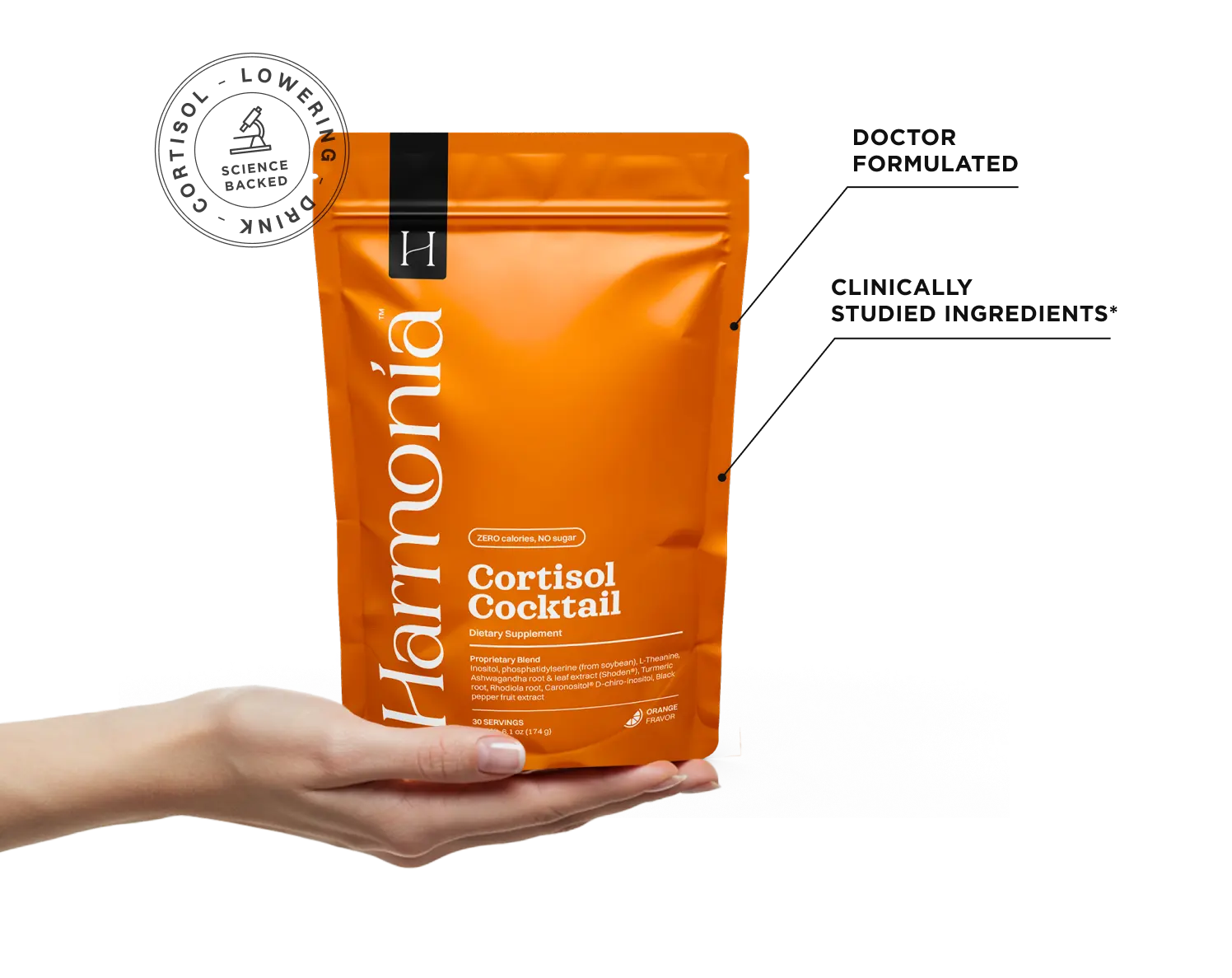
The Harmonia Cortisol Cocktail uses KSM-66 ashwagandha, a standardized root extract, as part of a caffeine-free formula designed around everyday stress support.
Can ashwagandha lower cortisol too much?
Very low cortisol has not been a typical finding in randomized ashwagandha trials.
There are, however, rare case reports describing adrenal suppression during ashwagandha use.
A 2022 case report described adrenal hypofunction that returned to normal after the supplement was stopped. A separate 2026 endocrine case report described prolonged HPA-axis suppression after more than a year of use.
These are individual cases, not evidence that this happens commonly.
If you already have unusually low cortisol, a diagnosed adrenal or endocrine condition, or you are being evaluated for one, discuss ashwagandha with your clinician before taking it.
Ashwagandha safety and who should be cautious
Ashwagandha is generally well tolerated by many adults when used short term.
The National Center for Complementary and Integrative Health describes short-term use as generally safe for most people. When side effects occur, they can include:
- drowsiness
- stomach upset
- diarrhea
- vomiting
NCCIH advises avoiding ashwagandha during pregnancy and breastfeeding. Medical guidance is also recommended for people with thyroid disorders, autoimmune conditions, upcoming surgery, or medications that affect blood sugar, blood pressure, seizures, immune function, sedation, or thyroid hormones.
Rare liver reactions have also been reported. A 2026 review of ashwagandha-associated liver injury identified 25 patients across 13 reports or case series, with most recovering after stopping the supplement.
If you take prescription medication or have a thyroid, autoimmune, endocrine, or significant liver condition, a clinician or pharmacist can help you review the specific product and dose you are considering.
Where Harmonia Cortisol Cocktail fits
%20(1).jpeg)
KSM-66 ashwagandha has a clear role in Harmonia: supporting the body's response to ongoing stress.
The Harmonia Cortisol Cocktail uses KSM-66, a standardized ashwagandha root extract, rather than a generic ashwagandha powder. That makes it easier to understand exactly which form of the ingredient is being used.
But ashwagandha is only one part of the formula.
The Harmonia Cortisol Cocktail ingredient list also includes L-theanine for calm focus, Rhodiola rosea for stress-related fatigue, magnesium for normal nervous-system function, and inositols involved in insulin and hormone signaling.
The idea is to support more than a cortisol number. Ongoing stress can also show up as poor sleep, low energy, scattered focus, cravings, or difficulty feeling like yourself. KSM-66 provides the core ashwagandha-based stress support, while the surrounding ingredients address other parts of that broader picture.
The bottom line
Yes, ashwagandha can lower cortisol in human studies.
Randomized trials and recent meta-analyses have found reductions in measured cortisol in adults experiencing stress, with many of the strongest studies looking at results after roughly 6 to 8 weeks.
How much it lowers cortisol varies from person to person and depends on the extract, dose, starting cortisol level, and other factors. It is better thought of as gradual stress-response support than as a way to rapidly "crush" cortisol.
For women looking for KSM-66 as part of a broader caffeine-free stress-support formula, the Harmonia Cortisol Cocktail combines it with ingredients selected for calm focus, stress-related fatigue, nervous-system support, and hormone-related signaling.
If stress keeps showing up in your sleep, focus, energy, cravings, or daily routine, you can take the Harmonia quiz to see whether the Cortisol Cocktail fits what you're experiencing.
FAQs
Does ashwagandha lower cortisol levels?
Yes. Several randomized human trials and recent meta-analyses have found lower measured cortisol after people with stress used standardized ashwagandha extracts for several weeks.
How much does ashwagandha lower cortisol?
The amount varies between studies. One 60-day trial reported a 27.9% reduction from baseline, while another reported about a 23% reduction in morning cortisol. Those figures describe study groups rather than a guaranteed personal result.
How quickly does ashwagandha lower cortisol?
Human research most often shows cortisol benefits after several weeks. Many key trials lasted about 60 days, so 6 to 8 weeks is a more evidence-based expectation than claims of an immediate cortisol change.
How much ashwagandha should you take to lower cortisol?
Research doesn't establish one universal amount because standardized extracts differ. Human cortisol studies have used daily amounts ranging from 240 mg to 600 mg and other preparations, so the extract name and concentration matter alongside the milligram number.
Can ashwagandha lower cortisol too much?
Very low cortisol hasn't been a typical finding in randomized trials. Rare case reports have described adrenal suppression during ashwagandha use. If you already have unusually low cortisol or a diagnosed adrenal or endocrine condition, discuss use with a clinician.
Does ashwagandha increase cortisol?
Controlled human studies mainly show cortisol decreasing in adults experiencing stress. Ashwagandha isn't established as a way to raise low cortisol, so people with unusually low cortisol should get medical guidance before using it.
References
• Fornalik, M., Malkiewicz, A., Adamczak, D., Nawrocki, F., Zielinska, A., & Mondal, S. A. (2026). Hormonal modulation with Withania somnifera: Systematic review and meta-analysis of randomized-controlled trials. Planta Medica, 92(8), 790-805. Link
• Albalawi, A. A. (2025). Dual impact of Ashwagandha: Significant cortisol reduction but no effects on perceived stress, a systematic review and meta-analysis. Nutrition & Health, 31(4). Link
• Chandrasekhar, K., Kapoor, J., & Anishetty, S. (2012). A prospective, randomized double-blind, placebo-controlled study of safety and efficacy of a high-concentration full-spectrum extract of ashwagandha root in reducing stress and anxiety in adults. Indian Journal of Psychological Medicine, 34(3), 255-262. Link
• Lopresti, A. L., Smith, S. J., Malvi, H., & Kodgule, R. (2019). An investigation into the stress-relieving and pharmacological actions of an ashwagandha (Withania somnifera) extract: A randomized, double-blind, placebo-controlled study. Medicine, 98(37), e17186. Link
• Majeed, M., Nagabhushanam, K., & Mundkur, L. (2023). A standardized Ashwagandha root extract alleviates stress, anxiety, and improves quality of life in healthy adults by modulating stress hormones: Results from a randomized, double-blind, placebo-controlled study. Medicine, 102(41), e35521. Link
• Gopukumar, K., et al. (2026). Efficacy and safety of Ashwagandha root extract sustained-release (AshwaSR) capsules in healthy adult, stressed subjects: A randomized, double-blind, placebo-controlled, parallel-group, 3-arm clinical trial. Medicine, 105(11), e47990. Link
• National Center for Complementary and Integrative Health. (2026). Ashwagandha: Usefulness and safety. National Institutes of Health. Link
• National Institutes of Health, Office of Dietary Supplements. Ashwagandha: Is it helpful for stress, anxiety, or sleep? Health Professional Fact Sheet. Link
• Fry, C. H., Fluck, D., & Han, T. S. (2022). Adrenal hypofunction associated with ashwagandha (Withania somnifera) supplementation: A case report. Toxicology and Environmental Health Sciences, 14, 141-145. Link
• Javid, J., Kunnuru, S. R., Anne, B., & Muskan, S. (2026). From herbal hope to hormonal havoc: Chronic ashwagandha use and HPA axis suppression. Endocrinology, Diabetes & Metabolism Case Reports, 2026(1), EDM250076. Link
• McIntyre, D., Nguyen, P., Kim, Y., Meyer, B., & Salloum, M. (2026). Ashwagandha (Withania somnifera)-associated liver injury: A scoping review of clinical characteristics and safety considerations. Cureus, 18(5), e109764. Link