Ashwagandha has become one of the most popular supplements for stress, sleep, and feeling more balanced during demanding periods. But some of the claims around it are much better supported than others.
The strongest human evidence is for stress support, with additional research showing lower cortisol, improvements in some anxiety measures, and modest benefits for sleep.
These effects also tend to build over time. Most clinical trials use ashwagandha every day for several weeks rather than treating it as something that works immediately after one dose.
What are the main benefits of ashwagandha?
Ashwagandha (Withania somnifera) is an herb traditionally used in Ayurvedic medicine and now commonly sold as a root powder or standardized extract.
It is often described as an adaptogen, meaning it is studied for how it may help the body respond to physical and psychological stress.
According to the NIH Office of Dietary Supplements review, human studies have looked particularly at stress, anxiety, cortisol, and sleep.
For women, the relevance of these benefits can change depending on the health concern. The research on ashwagandha's benefits for women looks more specifically at stress, sleep, PCOS, menopause, and hormone-related concerns.
1. Ashwagandha for Stress
Stress support is probably ashwagandha's best-established benefit.
In a 2012 trial of 64 adults with chronic stress, participants took either a concentrated ashwagandha root extract or placebo for 60 days. Those taking ashwagandha had greater improvements in perceived stress, along with lower cortisol.
The result does not stand alone.
A 2024 meta-analysis combining nine randomized trials and 558 participants found an overall pattern of lower stress and anxiety scores with ashwagandha, along with lower blood cortisol.
A larger 2026 meta-analysis of 22 randomized trials again found improvements in stress and anxiety outcomes.
The practical takeaway is that ashwagandha appears most useful for ongoing stress, with benefits generally studied after several weeks of regular use.
2. Ashwagandha for anxiety
Stress and anxiety often overlap, and some ashwagandha trials have found improvements in both.
A 2019 double-blind trial involving 60 stressed adults found that 240 mg per day of Shoden extract for 60 days improved scores on a standard anxiety scale compared with placebo.
Larger reviews have also found an overall reduction in anxiety scores across multiple studies.
The important distinction is that most of this research involves people experiencing elevated stress or anxiety symptoms. Ashwagandha has not been established as a replacement for evidence-based treatment of an anxiety disorder.
If anxiety is severe, new, causing panic attacks, or interfering with daily life, clinical evaluation is more appropriate than relying on a supplement alone.
3. Ashwagandha for a healthier cortisol response

Cortisol is one of the hormones your body releases as part of the stress response.
Several randomized trials have found lower cortisol after adults experiencing stress used ashwagandha for several weeks.
In both the 2012 and 2019 stress trials, cortisol fell more with ashwagandha than with placebo. The 2024 meta-analysis found the same overall pattern when researchers pooled results across multiple studies.
That does not mean cortisol is something you want to eliminate.
Cortisol helps regulate alertness, blood sugar, energy availability, and your daily sleep-wake rhythm. Understanding how cortisol supports a healthy stress response helps put the research into perspective.
The goal is better regulation of the stress response, not pushing cortisol as low as possible.
4. Ashwagandha for sleep
Ashwagandha may also help some people sleep better, particularly if they already struggle with sleep.
A 2021 systematic review and meta-analysis of five randomized trials found a modest overall improvement in sleep. The effects were stronger in people with insomnia and in studies lasting at least 8 weeks.
A separate KSM-66 study followed adults with and without insomnia who took 300 mg twice daily for 8 weeks.
Sleep improved in both groups, but the benefits were greater among people who started the study with insomnia.
That suggests ashwagandha is better thought of as gradual sleep support than as an immediate sleep aid.
The research on how ashwagandha affects sleep over time looks more closely at sleep quality, timing, and the doses tested in clinical trials.
How long does ashwagandha take to work?
Ashwagandha usually is not studied as a supplement that produces its full effect within hours or a few days.
Most positive trials have followed people for several weeks.
For example:
- stress and cortisol studies often last around 60 days
- anxiety studies commonly assess results after 6 to 8 weeks
- sleep studies often run for around 8 weeks
That does not mean everyone has to wait exactly 8 weeks to notice anything. It simply means several weeks of consistent use is where the research is strongest.
If stress is your main concern, look for whether demanding days start to feel easier to manage. If sleep is the goal, changes in how easily you fall asleep, nighttime waking, and how rested you feel may be more useful than expecting one dramatic effect.
How much ashwagandha do studies use?
There is no single dose that applies to every ashwagandha product.
Different extracts can have different concentrations, which means the milligram amount only makes sense when you know which preparation is being used.
KSM-66 and Shoden are standardized extracts with their own concentrations and research histories.
So 240 mg of one extract should not automatically be considered weaker than 600 mg of another.
When looking at a supplement, pay attention to:
- the extract name
- whether it uses root, leaf, or both
- the amount per serving
- the recommended daily serving
- any other active ingredients
A personal serving should also account for your health history and any medications you take.
Is ashwagandha safe?
Ashwagandha is generally well tolerated by many adults during short-term use.
Current NCCIH guidance lists common short-term side effects including:
- stomach upset
- diarrhea
- vomiting
- drowsiness
Most research covers use for several weeks to a few months, so continuous long-term use is less well studied.

Who should be cautious with ashwagandha?
Current guidance advises avoiding ashwagandha during pregnancy and breastfeeding.
Extra caution is also appropriate if you:
- have a thyroid disorder
- have an autoimmune condition
- are preparing for surgery
- have significant liver disease
- take medication for diabetes or blood pressure
- take thyroid medication
- use sedatives or immunosuppressants
Ashwagandha can influence thyroid hormones. A small randomized trial in adults with mild underactive thyroid found changes in thyroid measurements after 8 weeks.
Rare liver reactions have also been reported. A 2026 review of published cases identified 25 patients across 13 reports, with most recovering after stopping ashwagandha.
If you take prescription medication or have a thyroid, liver, or autoimmune condition, a clinician or pharmacist can help determine whether a particular product is appropriate.
Ashwagandha vs rhodiola: what's the difference?
Ashwagandha and rhodiola are both commonly described as adaptogens, but their research tends to emphasize different benefits.
Ashwagandha has stronger human evidence around:
- ongoing stress
- cortisol
- anxiety-related symptoms
- sleep
Rhodiola is more closely associated with research on:
- stress-related fatigue
- mental tiredness
- energy during demanding periods
That distinction can be useful when comparing rhodiola and ashwagandha and deciding which type of support better matches what you're experiencing.
Where ashwagandha fits in Harmonia
_11zon.jpeg)
Ashwagandha has a clear role in Harmonia: supporting the body's response to ongoing stress.
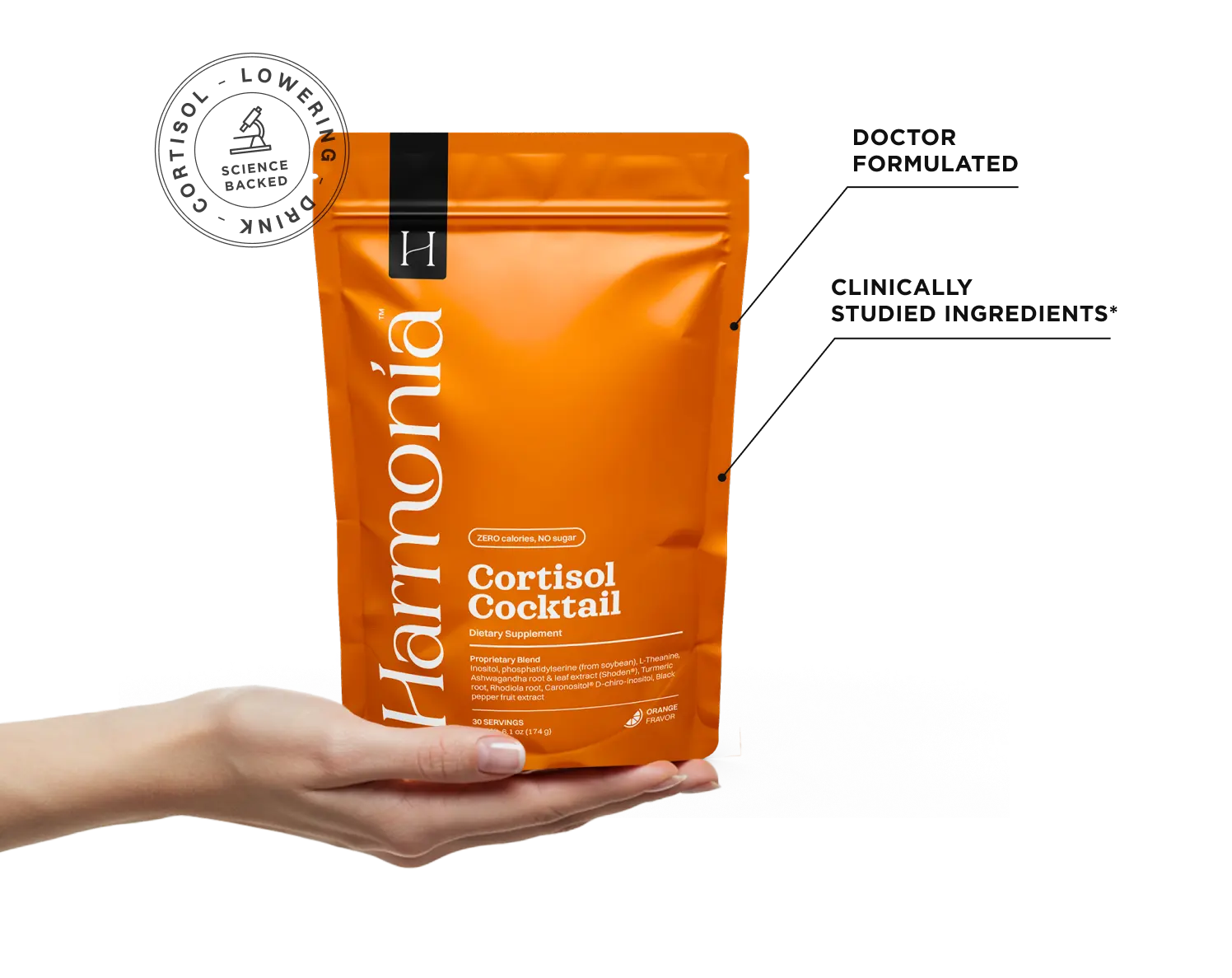
The Harmonia Cortisol Cocktail uses KSM-66, a standardized ashwagandha root extract with human research behind stress, cortisol, and sleep outcomes.
But KSM-66 is only one part of the formula.
The Harmonia Cortisol Cocktail ingredient list pairs it with L-theanine for calm focus, Rhodiola rosea for stress-related fatigue, magnesium for normal nervous-system function, and inositols involved in insulin and hormone signaling.
That combination is designed for the broader ways ongoing stress can show up, including feeling wired, mentally scattered, fatigued, or unable to switch off.
Ashwagandha contributes the core multi-week stress and cortisol support. It also has some of the clearest direct human evidence among supplements studied for cortisol support.
The bottom line
Ashwagandha is one of the better-studied herbal supplements for stress.
Its strongest evidence is for reducing perceived stress and supporting cortisol regulation, with additional research suggesting benefits for anxiety symptoms and sleep.
Those effects generally develop with consistent use over several weeks rather than appearing immediately after one dose.
The exact product matters too. Standardized extracts such as KSM-66 and Shoden have different concentrations and research histories, so comparing ashwagandha products only by milligrams can be misleading.
For women who want KSM-66 within a broader caffeine-free stress-support formula, the Harmonia Cortisol Cocktail pairs it with L-theanine, Rhodiola rosea, magnesium, and inositols that support other parts of the stress response.
If stress keeps showing up in your sleep, focus, energy, or day-to-day routine, you can take the Harmonia quiz to see whether the Cortisol Cocktail fits what you're experiencing.
Frequently asked questions
What is ashwagandha good for?
Ashwagandha is best known for stress support. Human studies also suggest benefits for cortisol, sleep, and some anxiety symptoms.
What is the biggest benefit of ashwagandha?
Stress support has one of the strongest research bases. Multiple randomized trials and meta-analyses have reported lower perceived-stress scores, often alongside lower cortisol.
Does ashwagandha lower cortisol?
Yes, several randomized trials have found lower cortisol in adults experiencing stress after several weeks of ashwagandha supplementation.
Does ashwagandha help with anxiety?
It may help reduce anxiety symptoms, particularly when anxiety overlaps with ongoing stress. It is not established as a replacement for treatment of an anxiety disorder.
Does ashwagandha help you sleep?
It may. Research suggests modest improvements in sleep overall, with stronger results in people who already have insomnia or other sleep difficulties.
How long does ashwagandha take to work?
Most clinical studies measure benefits after several weeks, often around 6 to 8 weeks. The exact timeline varies by person, extract, and outcome.
How much ashwagandha should you take?
There is no universal dose because extracts differ. Human trials commonly use standardized preparations providing roughly 240 to 600 mg per day, but the extract type matters as much as the milligram amount.
What is KSM-66 ashwagandha?
KSM-66 is a standardized ashwagandha root extract used in human clinical trials. Research specifically using KSM-66 applies most directly to products that contain that same extract.
Can you take ashwagandha every day?
Daily use is common in clinical trials lasting several weeks to a few months. Longer-term continuous use is less well studied.
Can ashwagandha affect your thyroid or medications?
Yes. Ashwagandha may affect thyroid hormone levels and can potentially interact with several types of medication, including medicines for diabetes, blood pressure, thyroid function, sedation, and immune suppression.
References
- National Institutes of Health, Office of Dietary Supplements. Ashwagandha: Is it helpful for stress, anxiety, or sleep? Fact Sheet for Health Professionals. Link
- National Center for Complementary and Integrative Health. Ashwagandha: Usefulness and Safety. Link
- Chandrasekhar, K., Kapoor, J., & Anishetty, S. (2012). A prospective, randomized double-blind, placebo-controlled study of safety and efficacy of a high-concentration full-spectrum extract of ashwagandha root in reducing stress and anxiety in adults. Indian Journal of Psychological Medicine, 34(3), 255-262. Link
- Lopresti, A. L., Smith, S. J., Malvi, H., & Kodgule, R. (2019). An investigation into the stress-relieving and pharmacological actions of an ashwagandha extract: A randomized, double-blind, placebo-controlled study. Medicine, 98(37), e17186. Link
- Arumugam, V., Vijayakumar, V., Balakrishnan, A., et al. (2024). Effects of ashwagandha (Withania somnifera) on stress and anxiety: A systematic review and meta-analysis. Explore, 20(6), 103062. Link
- Alsanie, S. A., Alhodieb, F. S., & Askarpour, M. (2026). Effects of ashwagandha (Withania somnifera) on mental health in adults: A systematic review and dose-response meta-analysis of randomized controlled trials. Complementary Therapies in Medicine, 97, 103325. Link
- Cheah, K. L., Norhayati, M. N., Yaacob, L. H., & Abdul Rahman, R. (2021). Effect of ashwagandha (Withania somnifera) extract on sleep: A systematic review and meta-analysis. PLOS ONE, 16(9), e0257843. Link
- Langade, D., Thakare, V., Kanchi, S., & Kelgane, S. (2021). Clinical evaluation of the pharmacological impact of ashwagandha root extract on sleep in healthy volunteers and insomnia patients: A double-blind, randomized, parallel-group, placebo-controlled study. Journal of Ethnopharmacology, 264, 113276. Link
- McIntyre, D., Nguyen, P., Kim, Y., Meyer, B., & Salloum, M. (2026). Ashwagandha (Withania somnifera)-associated liver injury: A scoping review of clinical characteristics and safety considerations. Cureus, 18(5), e109764. Link
- Sharma, A. K., Basu, I., & Singh, S. (2018). Efficacy and safety of ashwagandha root extract in subclinical hypothyroid patients: A double-blind, randomized placebo-controlled trial. Journal of Alternative and Complementary Medicine, 24(3), 243-248. Link