Myo-inositol and D-chiro-inositol often appear together in supplements for PCOS, insulin resistance, hormone support, and fertility. But what do they actually do, and why do so many formulas use a 40:1 ratio?
Both are forms of inositol involved in the way cells respond to insulin. Human research, especially in women with polycystic ovary syndrome (PCOS), suggests they may support insulin sensitivity, hormone levels, ovulation, and menstrual regularity.
The 40:1 combination gets a lot of attention, but the ratio is only part of the story. The type of inositol, total daily amount, and reason you're taking it matter too.
What are the benefits of myo-inositol and D-chiro-inositol?
The strongest research is in women with PCOS, particularly for insulin-related and hormone outcomes.
Studies suggest myo-inositol and D-chiro-inositol may help with:
What are myo-inositol and D-chiro-inositol?
Inositol is a family of naturally occurring compounds your body uses in cell membranes and signaling pathways. A 2019 review in Frontiers in Pharmacology describes myo-inositol and its derivatives as signaling molecules involved in metabolic and reproductive functions.
You may also see inositol called “vitamin B8” online, but it is not officially classified as a vitamin because your body can make it.
Myo-inositol vs D-chiro-inositol
Myo-inositol is the most abundant form in the body. Some of it can be converted into D-chiro-inositol, although the amount varies between tissues.
The difference between myo-inositol and inositol is mostly a matter of category versus form: “inositol” refers to the broader family, while myo-inositol is one specific type.

Why are they often taken together?
Both forms participate in insulin-related signaling, but they do not behave identically in every tissue.
That is why researchers have studied them both separately and in combination, particularly in PCOS. Combination formulas aim to include both pathways rather than relying on one form alone.
Why are inositols used for PCOS?
PCOS is where myo-inositol and D-chiro-inositol have been studied most extensively.
Insulin resistance is common in PCOS and can influence both metabolic health and reproductive hormones. That makes insulin signaling an important part of the condition for many women.
The 2023 international PCOS guideline says inositol can be considered for women with PCOS because it may improve some metabolic measures and tends to have limited gastrointestinal side effects.
A guideline-linked systematic review included 30 trials with 2,230 participants and reported improvements in fasting insulin and HOMA-IR in some studies.
A 2026 umbrella review also found favorable changes in insulin-related measures and several hormone markers.
Insulin resistance
Insulin acts like a signal telling cells to take up and use nutrients from the bloodstream. Inositol-related compounds help carry parts of that signal inside the cell.
That is one reason inositols have attracted so much interest in PCOS.
Improved insulin-related markers can matter even if someone does not lose much weight, which is why metabolic benefits and weight-loss benefits should not be treated as the same thing.
Hormone levels
Insulin and ovarian hormone production are closely connected in PCOS.
Some inositol studies report favorable changes in testosterone and sex hormone-binding globulin (SHBG), along with other reproductive markers.
The broader research on myo-inositol's effects on hormones also includes menstrual regularity, ovulation, and fertility-related outcomes.

Periods and ovulation
Some women with PCOS have irregular or infrequent ovulation, which can make menstrual cycles unpredictable.
Several inositol trials have reported improvements in menstrual regularity or ovulation. These changes usually take multiple weeks or cycles to assess, so they should not be viewed as guaranteed short-term effects.
The popular 40:1 combination has also been studied for ovulation.
Fertility
Inositol research has shown encouraging signals for ovulation and pregnancy in some women with PCOS or fertility concerns.
But fertility is more complicated than improving one hormone or insulin marker. Pregnancy and live birth depend on many factors, which is why current international guidance still considers inositol experimental for PCOS-related infertility.
Does myo-inositol help with weight loss?
Possibly, but weight loss is not where the evidence is strongest.
Myo-inositol may improve insulin-related markers even when body weight changes very little. Across PCOS trials, changes in weight and BMI have been inconsistent.
So if you're considering inositol mainly for weight loss, it is more useful to think about its potential role in insulin and metabolic health rather than expecting a predictable change on the scale.
The broader evidence on myo-inositol and body weight shows the same pattern: metabolic improvements can occur without substantial weight loss.
What does the 40:1 inositol ratio mean?
A 40:1 ratio simply means 40 parts myo-inositol for every 1 part D-chiro-inositol.
For example:
2,000 mg myo-inositol + 50 mg D-chiro-inositol = 40:1
The ratio tells you how the two forms are proportioned. It does not tell you whether that exact total daily amount is right for you.
Why is 40:1 so common?
One reason 40:1 has attracted attention is that blood measurements have found roughly 40 parts myo-inositol for every 1 part D-chiro-inositol.
But different tissues use the two forms in different proportions. The 2026 evidence review reports a ratio around 40:1 in plasma and closer to 100:1 in ovarian follicular fluid.
So the 40:1 ratio is a useful research reference, not proof that one ratio is ideal for everyone.
Is 40:1 the best ratio for PCOS?
It is one of the best-studied ratios.
A 2019 randomized trial compared seven different myo-inositol to D-chiro-inositol ratios in 56 women with PCOS. The 40:1 group had the strongest ovulation result among the tested groups.
However, each group contained only eight women, so the finding is promising rather than definitive.
A separate 2024 study followed 34 women with PCOS using a 40:1 formula for 12 weeks and reported improvements in insulin resistance and several hormone markers.
Together, these studies help explain why 40:1 is common in PCOS supplements. They do not establish it as the only useful ratio.
How much myo-inositol and D-chiro-inositol should you take?
There is no universal dose.
Studies use different amounts depending on the formulation and whether researchers are looking at insulin resistance, hormone levels, ovulation, fertility, or another outcome.
These are study protocols, not universal dosing instructions.

Morning or night?
There is no proven best time of day to take inositol.
Many studies divide the daily amount, but research supports consistency and total daily intake more strongly than a specific morning, evening, before-meal, or bedtime schedule.
If a clinician has recommended inositol for a specific condition, follow that plan. Otherwise, check the product label carefully so you know whether the listed amount refers to one serving or the full daily amount.
How long does myo-inositol take to work?
Inositol is generally studied over weeks or months rather than days.
Insulin-related markers may change within several weeks, while menstrual regularity, ovulation, and fertility outcomes often need longer follow-up.
There is no reliable “you'll notice it in 30 days” rule because the timeline depends on what you are trying to improve.
For PCOS-related outcomes, several studies have followed participants for roughly 6 to 24 weeks.
Myo-inositol and D-chiro-inositol side effects and safety
Myo-inositol and D-chiro-inositol are generally well tolerated in clinical studies.
When side effects occur, digestive symptoms tend to be the most common and are usually mild.
The systematic review used for the international PCOS guideline found fewer gastrointestinal side effects with myo-inositol than with metformin in trials that reported them.
However, side-effect reporting was incomplete in many studies, so less common and longer-term effects are not as well described.
Can inositol affect your period?
Cycle changes are one of the outcomes researchers study in women with PCOS.
Delayed periods or heavy bleeding have not been established as predictable inositol side effects.
If your cycle changes substantially after starting a supplement, other possibilities may include pregnancy, PCOS itself, medication changes, or another health change.
Can you take inositol while pregnant or trying to conceive?
Myo-inositol has been studied during pregnancy, particularly for gestational-diabetes prevention.
A 2023 Cochrane review of 7 randomized trials involving 1,319 pregnant women found some promising results, although confidence in several outcomes remained low.
Those findings apply specifically to the preparations studied and do not automatically apply to every myo-inositol plus D-chiro-inositol formula.
If you're pregnant, trying to conceive, using fertility medication, or managing diabetes, review the exact product and dose with your clinician.
How to choose a myo-inositol and D-chiro-inositol supplement
The front of a supplement package does not always tell you the whole story.
Two products can both advertise a 40:1 ratio while providing very different total amounts.
Check:
You can also calculate the ratio yourself.
For example, 2,000 mg of myo-inositol divided by 50 mg of D-chiro-inositol equals 40, giving a 40:1 ratio.
Where myo-inositol and D-chiro-inositol fit in Harmonia
_11zon.jpeg)
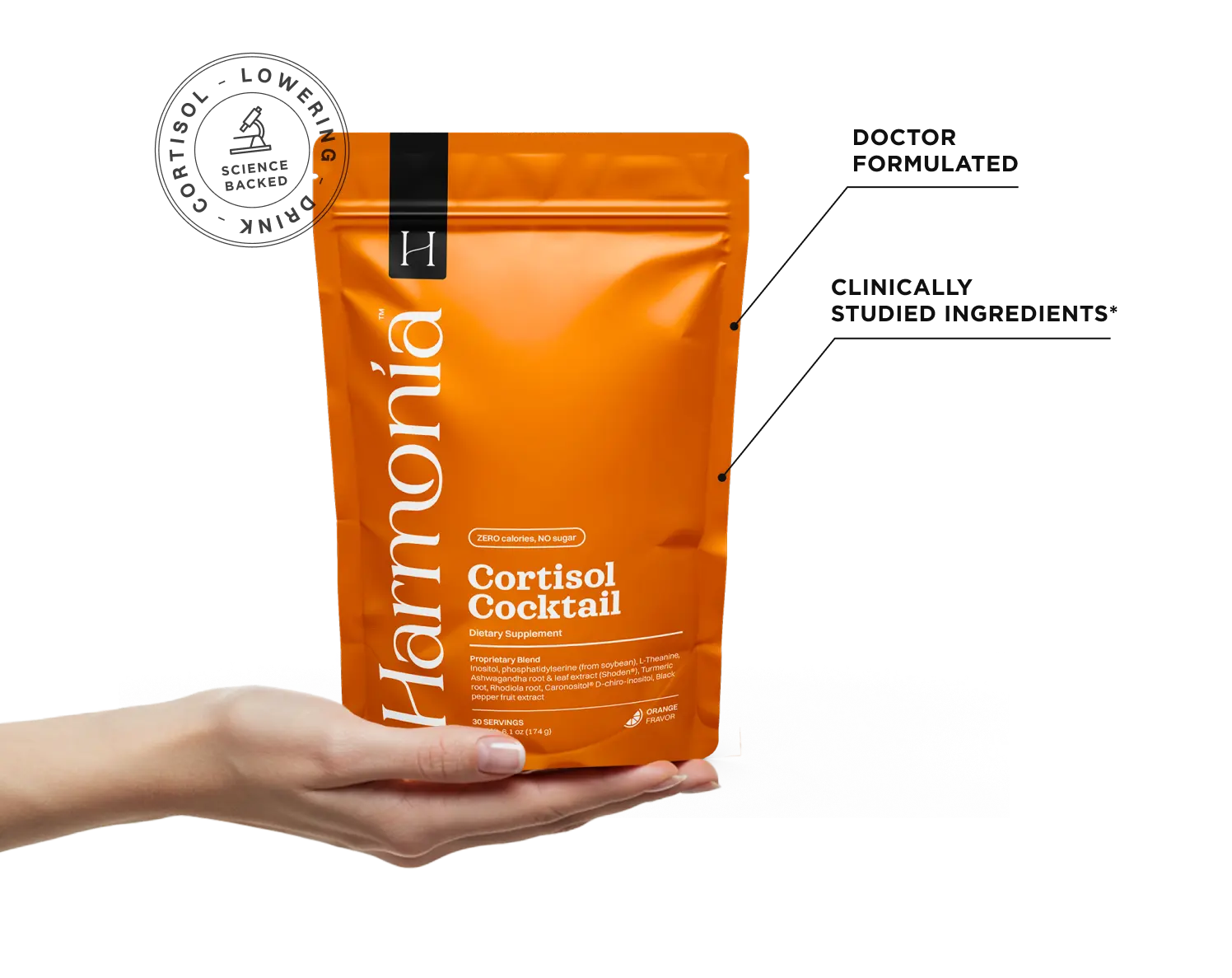
Myo-inositol and D-chiro-inositol give Harmonia a metabolic and hormone-signaling component alongside its broader stress-support ingredients.
The Harmonia Cortisol Cocktail ingredient list combines both forms of inositol with KSM-66 ashwagandha for stress and cortisol support, L-theanine for calm focus, Rhodiola rosea for stress-related fatigue, and magnesium for normal nervous-system function.
That combination may be particularly relevant when stress, cravings, changes in energy, and hormone-related symptoms tend to overlap.
The inositols contribute the insulin and hormone-signaling piece, while the surrounding ingredients focus on other parts of the stress response.
The PCOS, insulin, and hormone findings discussed in this article come from studies of inositol preparations themselves, not the finished Harmonia formula.
The bottom line
Myo-inositol and D-chiro-inositol are best supported for women with PCOS, particularly for insulin-related and some hormone outcomes.
Research also suggests potential benefits for ovulation and menstrual regularity, while fertility and weight-loss outcomes are less certain.
The 40:1 ratio is one of the most studied combinations, but it is not a magic number. The total amount, type of inositol, formulation, and reason you're taking it all matter.
For women who want both forms within a broader stress-support formula, the Harmonia Cortisol Cocktail combines myo-inositol and D-chiro-inositol with ingredients selected for stress response, calm focus, fatigue, and nervous-system support.
If stress, cravings, sleep changes, and hormone-related symptoms tend to cluster for you, you can take the Harmonia quiz to see whether the Cortisol Cocktail fits what you're experiencing.
Frequently asked questions
What are the benefits of myo-inositol and D-chiro-inositol?
The strongest evidence is in women with PCOS. Studies suggest possible benefits for insulin-related markers, some hormone levels, menstrual regularity, and ovulation. Fertility and weight-loss outcomes are less certain.
Is myo-inositol the same as D-chiro-inositol?
No. They are related forms within the inositol family. Myo-inositol is more abundant in the body, and tissues can convert some of it into D-chiro-inositol.
Should you take myo-inositol and D-chiro-inositol together?
Not necessarily. Researchers have studied myo-inositol alone, D-chiro-inositol alone, and combinations. Current PCOS guidance does not require everyone to use both forms.
Is a 40:1 inositol ratio best for PCOS?
40:1 is one of the most studied combinations and is common in PCOS supplements. A small randomized trial favored it for ovulation compared with several other ratios, but current evidence does not prove it is ideal for everyone.
How much myo-inositol and D-chiro-inositol should you take?
There is no universal dose. Clinical studies use different amounts and ratios depending on the formulation and outcome being studied. If you're using inositol for PCOS, infertility, or a metabolic condition, discuss the exact product with your clinician.
When is the best time to take inositol?
There is no proven best time. Many studies divide the daily amount, but consistency and total daily dose have stronger evidence than morning-versus-evening timing.
How long does myo-inositol take to work?
Most studies measure outcomes over several weeks to several months. Insulin markers may change sooner than menstrual, ovulation, or fertility outcomes.
Does myo-inositol help with weight loss?
Possibly, but weight loss is inconsistent across trials. Improvements in insulin-related markers are more consistent than reductions in weight or BMI.
Can inositol affect your period?
Inositol is studied partly because it may improve menstrual regularity in women with PCOS. Delayed periods or heavy bleeding are not established as predictable side effects.
Can you take myo-inositol and D-chiro-inositol while pregnant?
Myo-inositol has been studied during pregnancy, but those findings do not automatically apply to every combination product. Review the exact formula with your obstetric or medical team before using it during pregnancy.
References
- Chhetri, D. R. (2019). Myo-Inositol and Its Derivatives: Their Emerging Role in the Treatment of Human Diseases. Frontiers in Pharmacology, 10, 1172. Link
- Dinicola, S., et al. (2021). Inositols: From Established Knowledge to Novel Approaches. International Journal of Molecular Sciences, 22(19), 10575. Link
- Teede, H. J., et al. (2023). Recommendations from the 2023 International Evidence-based Guideline for the Assessment and Management of Polycystic Ovary Syndrome. Fertility and Sterility, 120(4), 767-793. Link
- Fitz, V., et al. (2024). Inositol for Polycystic Ovary Syndrome: A Systematic Review and Meta-analysis to Inform the 2023 Update of the International Evidence-based PCOS Guidelines. The Journal of Clinical Endocrinology & Metabolism, 109(6), 1630-1655. Link
- Duan, M., et al. (2026). Effects of inositol in women with polycystic ovary syndrome: an umbrella review of meta-analyses from randomized controlled trials. Frontiers in Endocrinology, 17, 1741509. Link
- Nordio, M., Basciani, S., & Camajani, E. (2019). The 40:1 myo-inositol/D-chiro-inositol plasma ratio is able to restore ovulation in PCOS patients: comparison with other ratios. European Review for Medical and Pharmacological Sciences, 23(12), 5512-5521. Link
- Pustotina, O., Myers, S. H., Unfer, V., & Rasulova, I. (2024). The Effects of Myo-Inositol and D-Chiro-Inositol in a Ratio 40:1 on Hormonal and Metabolic Profile in Women with Polycystic Ovary Syndrome. Gynecologic and Obstetric Investigation, 89(2), 131-139. Link
- Motuhifonua, S. K., Lin, L., Alsweiler, J., Crawford, T. J., & Crowther, C. A. (2023). Antenatal dietary supplementation with myo-inositol for preventing gestational diabetes. Cochrane Database of Systematic Reviews, Issue 2, CD011507. Link