Search “7 stages of adrenal fatigue” and you’ll find several different numbering systems. Some pages describe 3 stages. Others use 4, 7, or 8.
Many of these frameworks trace themselves to Hans Selye’s early stress research, although his work did not define adrenal fatigue or a seven-stage cortisol and DHEA sequence. His 1936 paper examined stress responses in rats rather than persistent fatigue in humans.
Later practitioners assigned symptom clusters to claimed cortisol and DHEA patterns. That is why the seven stages cannot be confirmed with a blood draw or saliva panel. They are an unvalidated way of organizing symptoms, not a recognized diagnosis.
Are there really 7 stages of adrenal fatigue?
The 7 stages of adrenal fatigue come from functional and integrative medicine frameworks rather than a diagnosis recognized in endocrinology. The model usually describes a sequence from early stress activation to prolonged exhaustion.
No standardized seven-stage system exists, no test can confirm a stage, and the same symptoms can come from iron deficiency, thyroid disease, depression, sleep disorders, perimenopause, medication effects, or adrenal insufficiency.
Where did the 7-stage model come from?
The model is often linked to Hans Selye’s General Adaptation Syndrome, a 1936 theory based on how rats responded to repeated physical stressors. Selye described 3 phases: alarm, resistance, and exhaustion.
His work described a broad biological response to stress. It did not identify an adrenal gland disorder or a sequence of cortisol and DHEA stages in people with persistent fatigue.
Functional and integrative practitioners later expanded the 3-phase concept into cortisol and DHEA charts. Different clinics divided those charts into different numbers of stages, which is how 3 phases became 4 stages, 7 stages, or 8 zones.
The hypothalamic-pituitary-adrenal axis governs cortisol release through a feedback loop involving the brain, pituitary gland, and adrenal glands. Cortisol changes with time of day, sleep, illness, medication, and recent demands. It does not follow a proven seven-point progression.
What are the 7 stages of adrenal fatigue?
There is no standardized seven-stage model. The table below is an editorial summary of one recurring sequence found across non-medical adrenal-fatigue frameworks. It shows how proponents commonly label the stages. It does not describe validated diagnostic criteria or a predictable biological progression.
Each stage below explains how the model is commonly presented. None is a medical diagnosis.
Stage 1: Early stress activation
Within the unvalidated seven-stage framework, stage 1 is described as a period when cortisol and DHEA both run high. People may report mild anxiety, trouble winding down, caffeine or sugar cravings, and lighter sleep.
These symptoms are common during busy or stressful periods. They do not prove that adrenal function has changed.
Stage 2: Sustained high alert
Within the framework, stage 2 keeps cortisol high while DHEA is said to begin falling. The usual description includes irritability, difficulty falling asleep despite feeling tired, and greater reliance on caffeine.
One symptom cluster cannot establish hormone levels. Sleep loss, anxiety, stimulant use, medication effects, and perimenopause can produce a similar pattern.
Stage 3: Prolonged resistance
Within the framework, stage 3 combines high cortisol with low DHEA. Proponents attach persistent fatigue, reduced libido, low mood, and frequent minor illness to this stage.
Those symptoms need a wider assessment because they can also occur with anemia, thyroid disease, depression, sleep disorders, and other recognized conditions.

Stage 4: Declining reserve
Within the framework, stage 4 is described as the point where cortisol and DHEA begin falling together. The symptoms usually include intense fatigue, reduced daily function, and poor recovery after ordinary activity.
Some versions call this stage “adrenal failure.” That label blurs the line between an unvalidated framework and recognized adrenal insufficiency. Adrenal crisis is the acute, life-threatening emergency associated with severe cortisol deficiency. It can involve vomiting, severe weakness, confusion, fainting, and dangerously low blood pressure.
A delayed crash after physical or mental activity needs separate attention. Post-exertional malaise can begin 12 to 48 hours after exertion and may occur in ME/CFS or post-viral illness. The CDC recommends activity management, often called pacing, to reduce symptom flares while the cause is evaluated.
Stage 5: Persistent exhaustion
Within the framework, stage 5 is described as low cortisol with variable DHEA. Weakness, body aches, poor stress tolerance, and a heavy need for rest are commonly attached to it.
These symptoms do not identify low cortisol. Adrenal insufficiency requires standard clinical testing, and body aches or exhaustion can have several other causes.
Stage 6: Dysregulated response
Within the framework, stage 6 describes inconsistent cortisol and DHEA patterns rather than a steady decline. Proponents connect it to agitation, mood shifts, and movement between wired and exhausted periods.
Changing symptoms still do not confirm a hormone stage. Sleep timing, medication, caffeine, illness, pain, anxiety, and menstrual-cycle changes can all affect how someone feels across the day.
Stage 7: Severe, prolonged exhaustion
Within the framework, stage 7 is the most severe label. It is usually described as very low cortisol and DHEA with profound exhaustion, unrefreshing sleep, and low mood.
This stage is sometimes confused with Addison’s disease. Addison’s disease is primary adrenal insufficiency, a rare disorder in which damaged adrenal glands do not produce enough cortisol and sometimes aldosterone. Autoimmune disease causes most cases in developed countries, although infections, bleeding, cancer, surgery, genetic disorders, and certain medicines can also damage the adrenal glands.
A systematic review of 58 studies found no substantiation for adrenal fatigue as a distinct medical condition. Ordinary chronic stress has not been shown to progress through these seven stages or turn into Addison’s disease.
Why do some sources list 3, 4, 7, or 8 stages?
Different stage counts exist because clinics divide the same broad stress-exhaustion idea in different ways.
The models are not interchangeable, and none comes from an endocrinology guideline. A person can be assigned different stages by different websites or clinics because the rules are not standardized.
What does medical evidence support instead?
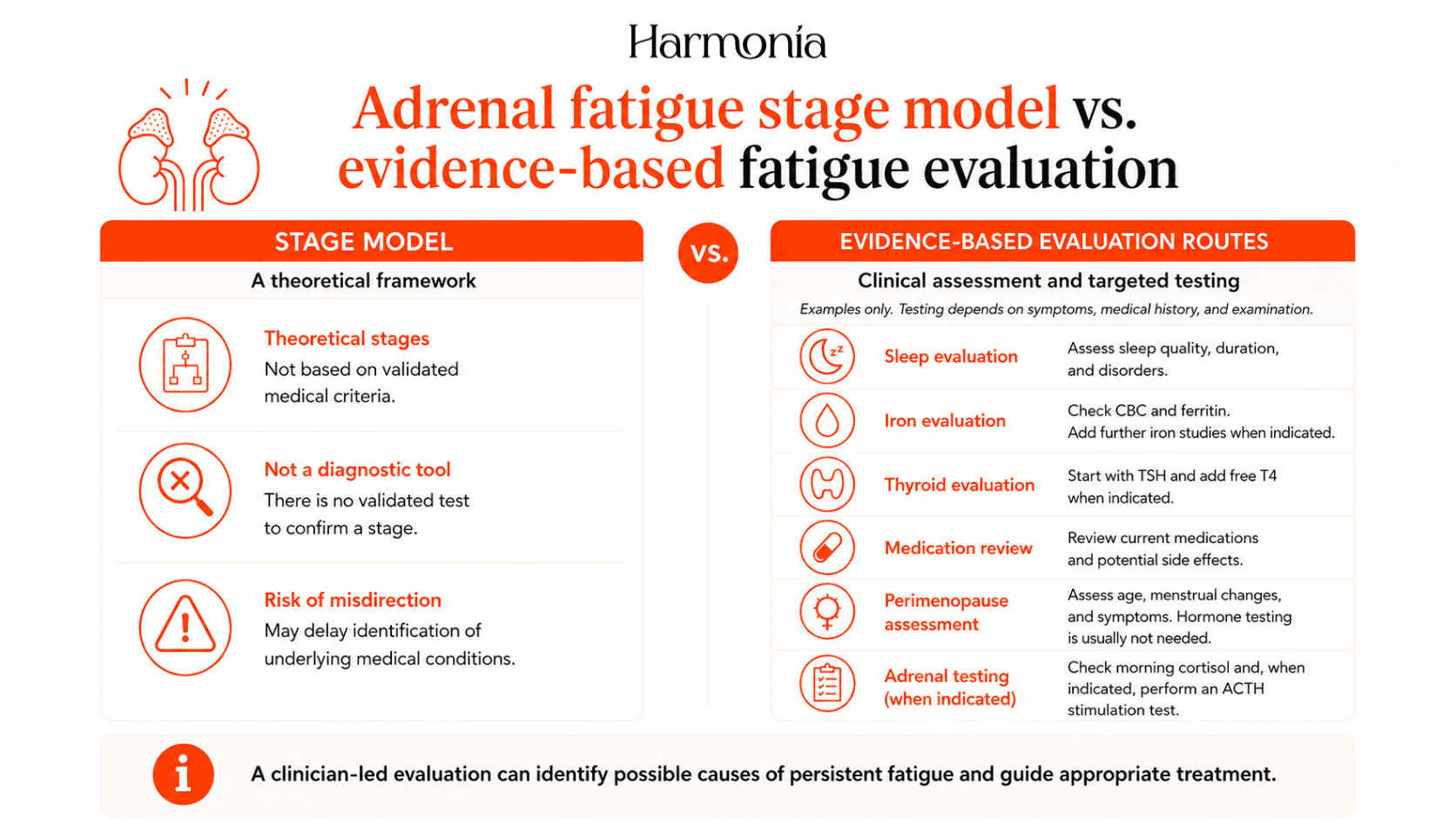
Medical evidence supports assessing persistent fatigue by its duration, symptom pattern, medication history, sleep, menstrual changes, recent infections, physical examination, and targeted testing. Recognized causes include iron deficiency, thyroid disease, sleep disorders, depression, perimenopause, medication effects, ME/CFS, post-viral illness, and adrenal insufficiency. No validated evidence shows that people move through seven predictable cortisol and DHEA stages.
Is adrenal fatigue a recognized medical diagnosis?
No. The Endocrine Society states that adrenal fatigue has no scientific proof or validated test. The organization warns that accepting the label can delay diagnosis of sleep apnea, depression, adrenal insufficiency, or another treatable cause of fatigue.
A 2025 review in the Journal of the Endocrine Society classified adrenal fatigue among unproven pseudo-endocrine disorders. It also warned that nonvalidated cortisol profiles and hormone-containing treatments can cause harm.
The symptoms remain real. The diagnosis attached to them needs to match recognized evidence and testing.
Can cortisol or DHEA testing tell you which stage you’re in?
No single blood, saliva, or urine result can place you on a seven-stage scale. The scale has no validated thresholds.
Cortisol changes across the day and responds to sleep, illness, medication, recent stress, and sample timing. One salivary cortisol sample reflects a single time point. Repeated samples can describe a daily pattern in research or selected clinical settings, but they cannot diagnose an adrenal-fatigue stage. A review of salivary cortisol as a stress biomarker explains why psychological and biological factors can change the result and its meaning.
DHEA also changes with age, sex, medication, and health status. Reading one cortisol or DHEA value as proof of a stage goes beyond what the test can support.
When adrenal insufficiency is suspected, clinicians use the symptom history and standard endocrine testing. Morning cortisol and ACTH help frame the question, while the ACTH stimulation test is the most commonly used confirmatory test. Testing for cortisol excess follows a different protocol.
What else can cause the same symptoms?
Fatigue, brain fog, sleep disruption, cravings, and low mood overlap with several recognized conditions.
Persistent fatigue deserves a targeted evaluation rather than a stage label. A clinician may review a complete blood count, ferritin, thyroid testing, sleep symptoms, mental health, menstrual history, medication use, and recent infections based on the pattern.
When fatigue needs medical evaluation
Fatigue lasting several weeks, reducing daily function, worsening over time, or appearing with weight loss, low blood pressure, heavy periods, breathing problems, mood changes, or recent steroid reduction deserves medical assessment.
The NIDDK description of adrenal insufficiency symptoms includes chronic fatigue, weakness, loss of appetite, weight loss, abdominal pain, nausea, vomiting, low blood pressure, dizziness, and salt craving. Darkening of the skin is more closely associated with primary adrenal insufficiency.
Seek urgent care for severe weakness, repeated vomiting or diarrhea, confusion, fainting, sudden severe abdominal or back pain, or very low blood pressure. Those signs can occur during adrenal crisis and should not wait for a home cortisol test or supplement trial.
What supports recovery from chronic stress symptoms?
Support starts with identifying the cause of the symptoms. Sleep, meal timing, stress management, and movement matched to your current capacity can reduce avoidable strain while a wider evaluation is underway.
The physiology in cortisol is not the enemy explains why normal cortisol activity supports waking, blood pressure, glucose availability, and the response to a demanding event. The difference between acute stress and chronic stress is a more useful frame than assigning yourself a fixed stage.
The CDC describes post-exertional malaise and pacing for people whose symptoms worsen 12 to 48 hours after activity. This pattern needs different advice from a generic recommendation to exercise more.
For practical day-to-day support, how to reverse adrenal fatigue naturally covers sleep, meals, caffeine, and recovery without treating adrenal fatigue as a medical diagnosis. The guide to adrenal fatigue supplements separates ingredient evidence from unsupported adrenal-rebuilding claims.
Where Harmonia fits
If ongoing stress is affecting your sleep, energy, resilience, or ability to recover, Harmonia provides a practical way to support your daily stress routine while you address the bigger picture.
The Harmonia cortisol cocktail combines evidence-backed ingredients including ashwagandha, rhodiola, L-theanine, myo-inositol, magnesium, and essential vitamins. Rather than relying on a single ingredient, the formula brings together nutrients studied for different aspects of the stress response, from perceived stress and resilience to calm, sleep quality, and metabolic support.
Ashwagandha has the strongest human evidence within the formula, with clinical studies reporting improvements in perceived stress and selected cortisol measures. Rhodiola has also shown promising results for stress-related fatigue and resilience. While these findings cannot predict the effects of the finished formula or validate the concept of "adrenal fatigue," they provide a science-informed foundation for supporting everyday stress.
Harmonia is designed for general wellness, not for diagnosing or treating adrenal insufficiency, endocrine disorders, or the unvalidated stages of adrenal fatigue. If your symptoms are severe, worsening, or accompanied by unexplained weight loss, persistent low blood pressure, or recent steroid use, medical evaluation should come first.
_11zon.jpeg)
The bottom line
The 7 stages of adrenal fatigue are an unvalidated way of organizing stress-related symptoms. The model grew from a general stress theory and later cortisol-DHEA charts rather than research proving seven stages in humans.
Persistent or severe fatigue still deserves a specific evaluation. The most useful next step is a clear symptom timeline, medication list, sleep history, menstrual history, and targeted testing based on the pattern.
If stress keeps showing up across sleep, energy, cravings, or mood after the basic medical questions have been considered, you can take the quiz to see whether the Harmonia Cortisol Cocktail fits what you are experiencing right now.
References
- Selye, H. (1936). A syndrome produced by diverse nocuous agents. Nature, 138, 32. Link
- Cadegiani, F. A., & Kater, C. E. (2016). Adrenal fatigue does not exist: A systematic review. BMC Endocrine Disorders, 16, 48. Link
- Endocrine Society. (2022). Adrenal fatigue. Link
- McDermott, M. T. (2025). Pseudo-endocrine disorders: Recognition, management, and action. Journal of the Endocrine Society, 9(1), bvae226. Link
- National Institute of Diabetes and Digestive and Kidney Diseases. Symptoms and causes of adrenal insufficiency and Addison’s disease. Link
- National Institute of Diabetes and Digestive and Kidney Diseases. Diagnosis of adrenal insufficiency and Addison’s disease. Link
- Hellhammer, D. H., Wüst, S., & Kudielka, B. M. (2009). Salivary cortisol as a biomarker in stress research. Psychoneuroendocrinology, 34(2), 163–171. Link
- Arumugam, V., et al. (2024). Effects of ashwagandha (Withania somnifera) on stress and anxiety: A systematic review and meta-analysis. Explore, 20(6), 103062. Link
- Olsson, E. M., von Schéele, B., & Panossian, A. G. (2009). A randomized, double-blind, placebo-controlled study of SHR-5 Rhodiola rosea in stress-related fatigue. Planta Medica, 75(2), 105–112. Link
- Centers for Disease Control and Prevention. (2024). Strategies to prevent worsening of symptoms in ME/CFS. Link