The most effective herbs to lower cortisol work by regulating the HPA axis rather than simply sedating the nervous system. That distinction matters because sedation and stress resilience are not the same thing. Sedation blunts your response. Resilience means your cortisol rises when you need it and falls when you don't.
Chronic stress keeps cortisol elevated far beyond what the body was designed to sustain. Work pressure, poor sleep, blood sugar swings, restrictive dieting, and emotional load all send repeated activation signals to the HPA axis. Over time, the system stops returning cleanly to baseline.
The result is a recognizable cluster of symptoms: difficulty falling or staying asleep, the wired-but-exhausted feeling, persistent anxiety or irritability, intense carb cravings, fat gain that resists diet and exercise, and hormonal imbalances. These seven herbs address that pattern at the source.
What Is Cortisol and Why Does It Get Too High?
Cortisol is produced by the adrenal glands and follows a predictable daily rhythm: highest in the morning to drive alertness, gradually declining through the afternoon, and low at night to allow rest. When that rhythm breaks down, the downstream effects touch every system in the body.
Under normal circumstances, cortisol follows a predictable daily rhythm: highest in the morning to help you wake up and gradually declining throughout the day so the body can rest at night.
Problems arise when cortisol stays elevated for too long.
Chronic stress - from work pressure, emotional strain, poor sleep, restrictive dieting, blood sugar swings, or overexercising - keeps the body in a constant state of “alert.”
This signals the brain to repeatedly activate the hypothalamic-pituitary-adrenal (HPA) axis, driving cortisol production around the clock.
Over time, this dysregulation can lead to symptoms such as:
- Difficulty falling or staying asleep
- Feeling wired but exhausted
- Increased anxiety or irritability
- Intense carb or sugar cravings
- Fat gain that feels resistant to diet and exercise
- Hormonal imbalances
Can Herbs Really Lower Cortisol? What the Science Says
Yes, but only a specific category of herbs has clinical evidence behind it. Adaptogenic and stress-modulating herbs have been shown to influence HPA axis activity, and the mechanism is regulation rather than suppression.
Rather than forcing cortisol down, these herbs help regulate the HPA axis so cortisol rises when needed and falls when it should.
Clinical research shows that certain herbs can:
- Reduce excessive cortisol release
- Improve resilience to psychological and physical stress
- Support neurotransmitters involved in calm and focus
- Improve sleep quality and nighttime cortisol patterns
This is why herbs are often considered some of the most effective natural ways to lower cortisol, especially when compared to short-term solutions like stimulants, alcohol, or sleep aids.
7 Proven Herbs to Lower Cortisol Naturally
_11zon.png)
1. Ashwagandha
Ashwagandha has the strongest clinical evidence of any adaptogen for directly reducing serum cortisol in chronically stressed individuals.
Classified as an adaptogen, it helps the body adapt to stress by stabilizing HPA axis activity. A 2025 systematic review and meta-analysis confirmed that ashwagandha supplementation significantly reduces cortisol levels alongside measurable improvements in anxiety, fatigue, and sleep quality.
It's particularly useful for chronic psychological stress, anxiety and tension, poor sleep linked to elevated cortisol, and hormonal imbalances driven by HPA axis overactivation. By supporting cortisol balance, ashwagandha indirectly stabilizes blood sugar, reduces emotional eating, and improves overall stress resilience.
2. Rhodiola Rosea
Rhodiola rosea reduces cortisol spikes during acute stress while simultaneously improving mental clarity and stamina. It doesn't calm by slowing the system down; it raises the threshold at which the system activates.
Rhodiola rosea works differently than sedative herbs. Instead of calming by slowing the body down, it enhances stress tolerance and mental endurance.
Research shows that rhodiola helps reduce cortisol spikes during stressful situations while improving mental clarity, stamina, and emotional stability. This makes it especially useful for people who feel overwhelmed, burned out, or mentally exhausted.
Rhodiola is well-suited for:
- Stress-related fatigue
- Burnout and emotional exhaustion
- Brain fog linked to stress
- Cortisol spikes triggered by pressure or workload
Unlike stimulants, rhodiola supports steady energy without increasing anxiety.
3. Holy Basil (Tulsi)
Holy basil modulates cortisol through two pathways: calming the nervous system and stabilizing blood sugar, which is a meaningful combination because blood sugar instability is itself a cortisol trigger.
Holy basil helps calm the nervous system while supporting balanced blood sugar levels - an important factor since blood sugar instability can drive cortisol higher.
It is particularly beneficial for:
- Stress-related anxiety
- Emotional eating
- Blood sugar-related cortisol fluctuations
- Nervous tension and irritability
Holy basil’s gentle calming effect makes it suitable for daily use without sedation.
4. Lemon Balm (Melissa officinalis)
Lemon balm works primarily by supporting GABA activity in the brain. GABA is the neurotransmitter that signals safety to the nervous system. When GABA activity rises, stress signaling decreases, and cortisol release follows.
One of lemon balm’s key benefits is its ability to support GABA activity in the brain. GABA is a neurotransmitter that promotes relaxation and signals safety to the nervous system. When GABA activity increases, the brain reduces stress signaling, which in turn lowers excessive cortisol release.
Lemon balm has also been shown to improve mood, cognitive performance under stress, and sleep quality - three areas commonly disrupted by high cortisol.
Lemon balm is especially helpful for people who:
- Experience anxiety-driven cortisol spikes
- Have trouble winding down mentally
- Struggle with stress-related sleep issues
- Feel tense or restless during the day
Because it is gentle and non-sedating at moderate doses, lemon balm is well-suited for daily use.
5. Schisandra Berry (Schisandra chinensis)

Schisandra supports cortisol regulation by helping the HPA axis normalize output during prolonged physical or emotional stress. Unlike herbs that simply calm the nervous system, it improves how the body adapts to stress, reducing the hormonal strain that leads to elevated cortisol.
Research suggests that schisandra supports the hypothalamic-pituitary-adrenal (HPA) axis, helping normalize cortisol output during prolonged physical or emotional stress. It also supports liver function, which plays a role in metabolizing stress hormones and maintaining hormonal balance.
Schisandra is commonly used to combat fatigue, improve mental clarity, and stabilize energy levels without overstimulation - making it particularly useful for people experiencing burnout or chronic stress.
Schisandra may be beneficial for individuals who:
- Feel depleted or burned out
- Experience stress-related fatigue
- Have difficulty maintaining steady energy
- Are exposed to ongoing psychological or physical stress
Its dual action - supporting both stress adaptation and recovery - makes schisandra a strong addition to any cortisol-lowering herbal strategy.
6. Turmeric (Curcumin)
Turmeric doesn't directly suppress cortisol. It addresses two of cortisol's most common upstream drivers: chronic inflammation and insulin resistance.
Chronic inflammation signals the body that it is under threat, which can perpetuate cortisol release. Curcumin helps calm this inflammatory response, indirectly supporting healthier cortisol regulation.
Turmeric is especially useful for:
- Stress combined with metabolic issues
- Inflammation-driven fatigue
- Blood sugar dysregulation
- Hormonal imbalances influenced by insulin resistance
When combined with other stress-modulating compounds, turmeric supports long-term cortisol balance.
7. Magnolia Bark
Magnolia bark's bioactive compounds interact with the nervous system to reduce anxiety and support relaxation without dependency. It works at the level of the stress response itself rather than masking symptoms.
Magnolia bark is particularly effective for:
- Anxiety-driven cortisol elevation
- Restlessness at night
- Stress-related sleep difficulties
It works well in formulas designed to calm both the mind and the stress response without creating dependency.
Herbs vs Supplements to Lower Cortisol
Single herbs can be effective, but cortisol dysregulation rarely travels alone. Stress affects neurotransmitters, blood sugar, inflammation, reproductive hormones, and sleep architecture at the same time.
Well-designed supplements combine multiple herbs with supporting nutrients. Magnesium supports the nervous system and directly dampens HPA axis reactivity.
The relationship between magnesium and cortisol is one of the more underappreciated mechanisms in stress nutrition: magnesium deficiency amplifies cortisol release, and chronic stress depletes magnesium. B vitamins support adrenal function and energy metabolism. Amino acids like L-theanine reduce physiological stress responses without sedation.
Formulation also shapes outcomes. Liquid and powdered formats improve absorption and support consistency, which matters because cortisol regulation responds to sustained daily input, not acute dosing. Onset is typically 4 to 8 weeks for measurable cortisol changes in most adaptogen trials.
Who Can Benefit Most From Cortisol-Lowering Herbs?

CWomen dealing with chronic stress or anxiety tend to see the most consistent benefit, particularly those where hormonal imbalances tied to PCOS or perimenopause are amplifying the stress response.
Poor sleep despite exhaustion, stress-related cravings and weight gain, and the stuck-in-burnout feeling are the symptom profiles where these herbs have the strongest track record. For a closer look at what chronic HPA axis overactivation looks like when it compounds over time, cortisol burnout covers the progression and what to do about it.
Supporting cortisol naturally improves not just stress levels but energy, mood, sleep, and cycle regularity, because cortisol is upstream of all of them.
Are There Side Effects or Safety Concerns?
Most cortisol-lowering herbs are well-tolerated at standard doses. Pregnant or breastfeeding women should consult a healthcare provider before adding any adaptogen. People on medications, particularly thyroid drugs, immunosuppressants, or sedatives, should check for herb-drug interactions, as ashwagandha and lemon balm both have relevant interaction profiles.
Dose matters more than most people expect. Higher doses don't consistently produce stronger effects, and balanced multi-herb formulas are often safer and more effective than high-dose single ingredients. If you're unsure where to start, how to lower cortisol naturally covers the full lifestyle and nutritional framework these herbs fit into.
Where Harmonia fits
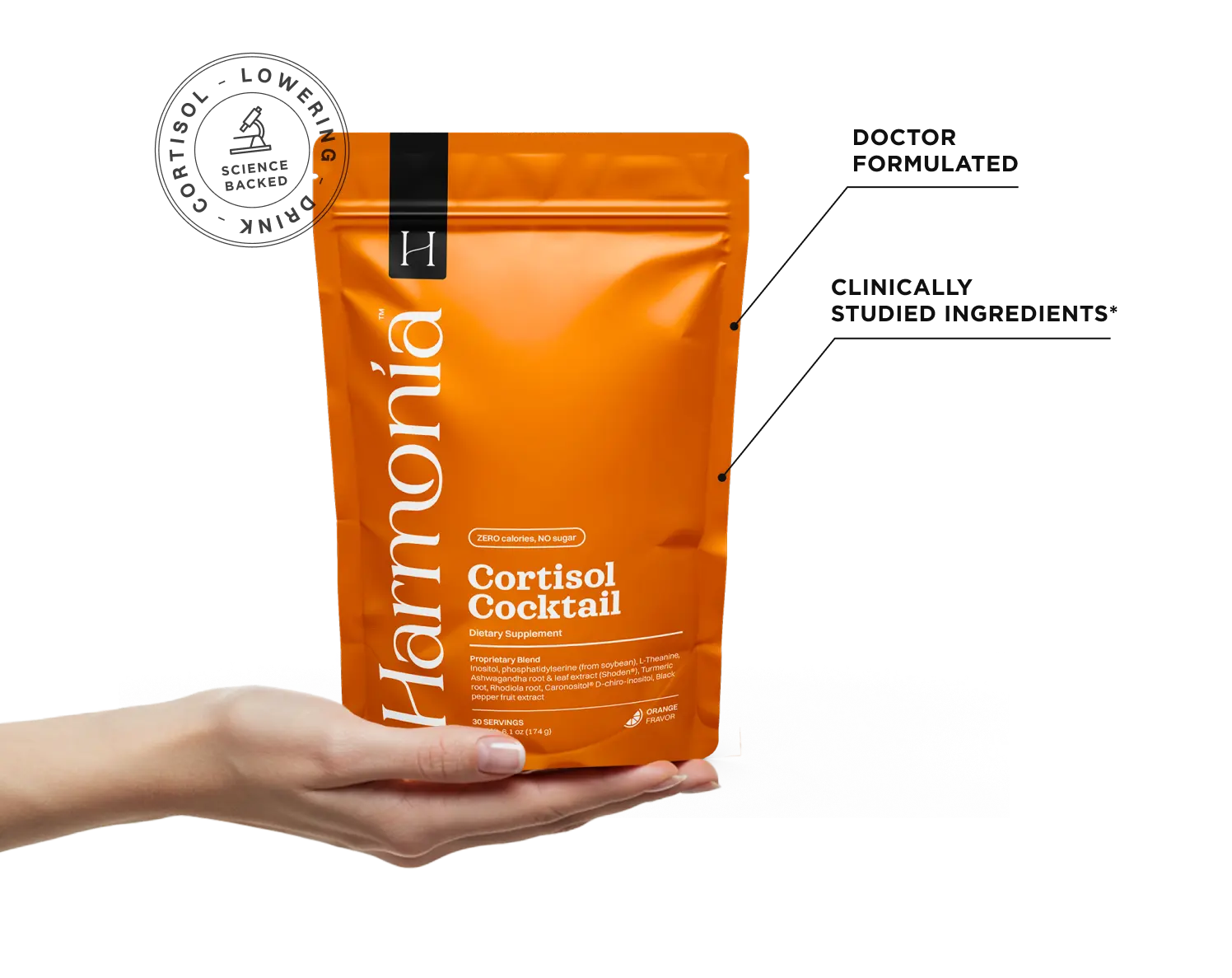
Most of the herbs in this article, ashwagandha, rhodiola, L-theanine, turmeric, and phosphatidylserine, are included in the Harmonia Cortisol Cocktail because of specific mechanisms, not because they're popular adaptogen names.
KSM-66 ashwagandha is included because that specific extract is what the clinical trials used. Phosphatidylserine is included because it modulates the HPA axis response to exercise stress, blunting post-workout cortisol spikes. L-theanine is included because it reduces physiological stress responses without sedation, which is what makes the formula usable during the day.
The powdered format is also intentional: absorption is faster than capsule, and daily consistency drives the cortisol benefits that show up in adaptogen trials.
The bottom line
The most effective herbs to lower cortisol work by regulating the HPA axis over time, not by suppressing cortisol acutely. Ashwagandha has the strongest clinical evidence. Rhodiola, lemon balm, holy basil, schisandra, turmeric, and magnolia bark each address different aspects of the stress response, which is why multi-herb combinations tend to outperform single ingredients.
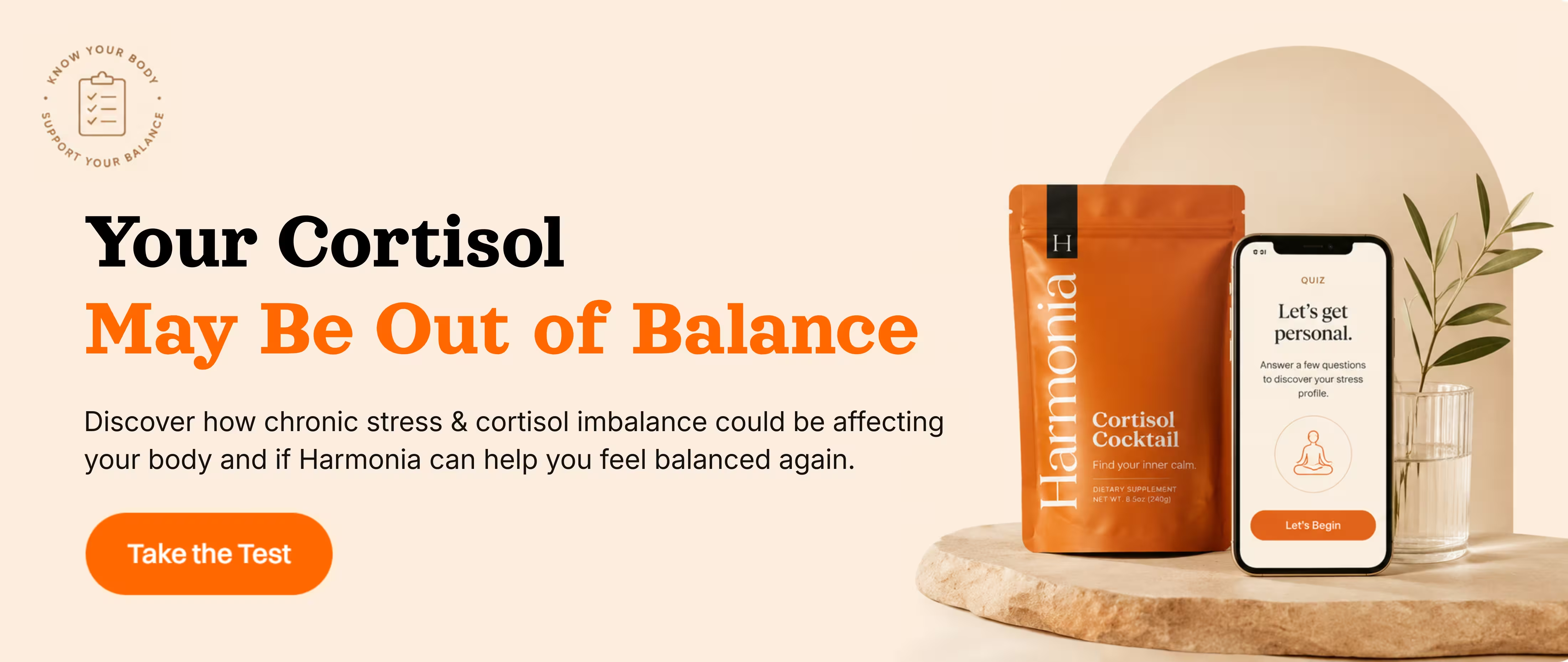
If you want to understand which combination fits your symptom pattern, you can take the quiz to see whether the Harmonia Cortisol Cocktail is the right fit for where you are right now.
Frequently Asked Questions
What herb lowers cortisol the most?
Ashwagandha has the strongest clinical evidence for reducing cortisol in chronically stressed individuals.
Can supplements really reduce cortisol?
Yes, when they contain clinically studied ingredients and are used consistently.
Is it better to take cortisol-lowering herbs in the morning or at night?
It depends on the formulation. Some support daytime stress resilience, while others help reduce nighttime cortisol and improve sleep.
References
- Anghelescu, I. G., Edwards, D., Seifritz, E., & Kasper, S. (2018). Stress management and the role of Rhodiola rosea: a review. International journal of psychiatry in clinical practice, 22(4), 242-252. Link.
- Bachour, G., Samir, A., Haddad, S., Houssaini, M. A., & El Radad, M. (2025). Effects of Ashwagandha Supplements on Cortisol, Stress, and Anxiety Levels in Adults: A Systematic Review and Meta-Analysis. BJPsych Open, 11(S1), S39-S39. Link.
- Lopresti, A. L., Smith, S. J., & Drummond, P. D. (2022). Modulation of the hypothalamic–pituitary–adrenal (HPA) axis by plants and phytonutrients: a systematic review of human trials. Nutritional neuroscience, 25(8), 1704-1730. Link.
- Mathews, I. M., Eastwood, J., Lamport, D. J., Cozannet, R. L., Fanca-Berthon, P., & Williams, C. M. (2024). Clinical efficacy and tolerability of lemon balm (Melissa officinalis L.) in psychological well-being: A review. Nutrients, 16(20), 3545. Link.
- Najar, I. A., Pamu, S., Patyar, S., Madhira, G., Sharma, A., Devi, S., ... & Kumar, M. (2025). Stress Management Therapy through Adaptogens and Rasayanas in Ayurveda: A Comprehensive Review. Current Drug Therapy, 20(4), 564-580. Link.
- Nambi Namusisi, H. (2025). Narrative review of plant-based adaptogens in stress management. Link.
- Sah¹&, A. K., Vijaysimha, M., & Mahamood, M. (2018). The Tulsi, Queen of Green Medicines: Biochemistry and Pathophysiology–A Review. Link.
- Solati, K., Heidari-Soureshjani, S., & Pocock, L. (2017). Effects and mechanisms of medicinal plants on stress hormone (cortisol): A systematic review. Middle East Journal of Family Medicine, 7, 117. Link.